
Before industrialization, wood was not forced: it was understood.
Each assembly was a direct response to a specific need – resistance, movement, weight, time – and not a decorative gesture. In antique furniture, the structure is not hidden: it is declared.
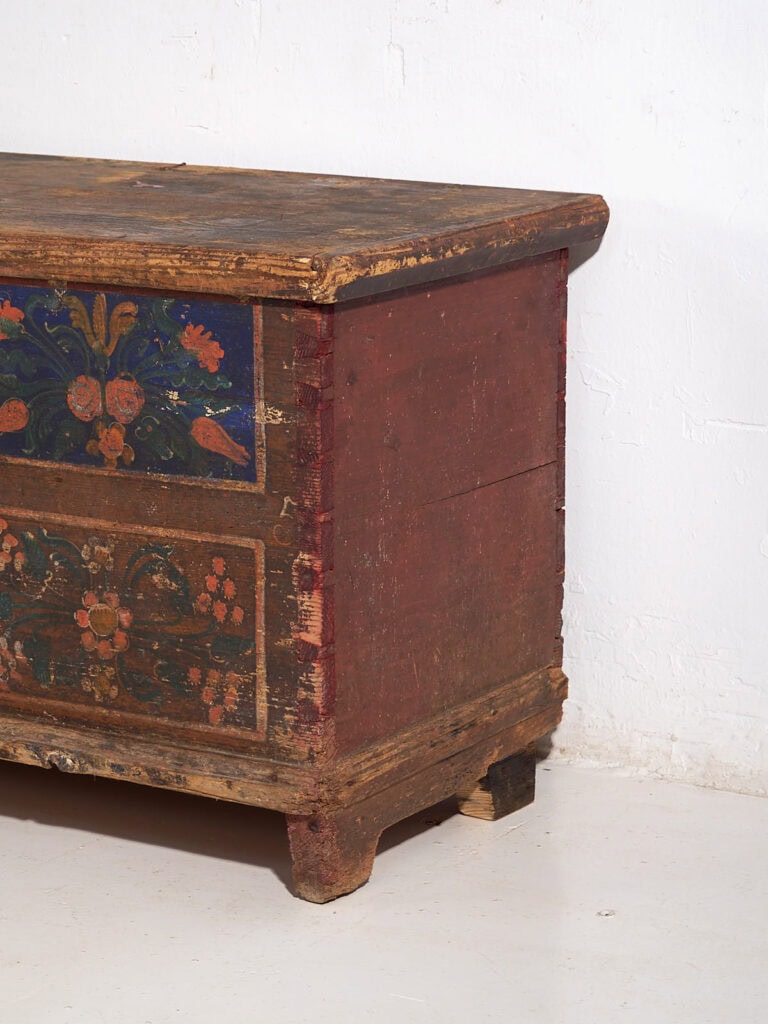
One of the most recognizable systems is the dovetail, used for centuries in Europe and Asia. Its shape, wider at the end than at the base, prevents the pieces from pulling apart. It is an honest, visible assembly, designed to last for generations, especially common in everyday drawers.
The mortise and tenon assembly is perhaps the most universal. One piece fits into another as if it had been designed for it from the beginning. It was used in load-bearing structures – tables, chairs, cabinets – where stability was essential. Well executed, it does not need nails or metal reinforcement.

In many rural or work furniture we find the half-wood assembly, where two pieces are lowered and crossed at the same level. It is simple, effective and easy to repair, a fundamental quality in contexts where the furniture was meant to last a lifetime.
In Asia, and especially in Japan, joinery has reached an almost architectural level. Traditional Japanese joints allow wood to expand and contract with humidity without breaking. In furniture such as tansu, precision replaces excess: each joint serves an exact function.
There were also assemblies designed for disassembly and transport. In chests, chests and antique domestic furniture, the joints made it possible to separate parts of the furniture without damaging it, anticipating a mobility that today we consider modern.
What all these systems have in common is a clear idea: wood is alive. It moves, it breathes, it ages. Ancient craftsmen did not fight against it, they worked with that movement, they accepted it as part of the design.
That is why, when we look inside an antique piece of furniture – a drawer, a back, a corner – we understand something essential: beauty is not only on the surface, but in the silent intelligence that supports it.
At Amaru Antiques we value these assemblies because they tell a story that cannot be falsified. They are the direct trace of an expert hand and of a time when building well was a form of respect: towards the material, towards the object and towards those who would use it later.
An antique piece of furniture is not only looked at.
It is read, always starting with its joints.